As my term as The Royal Australian College of General Practitioners (RACGP) President draws to a close, I’m grateful for the opportunity to reflect on my time leading the College. During this time, I have focused on growing and supporting our general practitioner (GP) workforce, getting greater funding and recognition for the complex work we provide, and advocating for and being the voice of members all around the country.
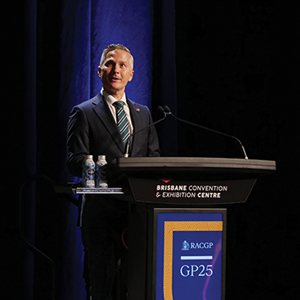
Delivering my keynote address at GP25.
My first task as President was launching the RACGP’s 2025–29 Strategy,1 which clearly articulates the work of the College embedding general practice at the heart of Australia’s health system. We developed and launched our 2026–30 Advocacy Plan,2 have grown our GP Advocate Network to more than 150 GP advocates, and expanded GPs@Parliament events – where GPs meet and inform local politicians about the realities and value of providing high-quality general practice care – across multiple states, as well as our landmark national event.3
We saw some major successes in response to RACGP advocacy. This included new incentives supporting junior doctors to become GPs, including paid study and parental leave, within the Federal Government’s $223 million GP Training Incentive Payments package. The RACGP’s success in general practice training has been recognised with a 5-year $751 million extension of the Australian General Practice Training Grant, the largest grant ever awarded to a medical college.4
We saw general practice funding placed front and centre in the last federal election, and a bilateral commitment to an $8.5 billion increase in Medicare investment – the largest in the past 40 years. Although the scale of the investment was welcomed, strings attached in the form of bulk billing have been contentious and risk embedding a two-tier Medicare system for our patients and practices. We also saw major additional funding in services targeting contraception and women’s health, and recognition of the increasing ability of GPs to provide complex care (most notably in attention deficit hyperactivity disorder).
The RACGP Hackathon returned,5 and we saw the launch of RACGP’s anti-racism statement6 as well as the RACGP’s updated climate change policy,7 highlighting the power of GPs to implement change as a profession. We have also advocated strongly for scope-of-practice changes to be based in evidence and safety, not just convenience.
We released the landmark 10th edition of Health of the Nation,8 which I have been proud to be involved with since its inception. The 2026 report had record participation and shows the increasingly complex care being provided by GPs for a very modest health system investment, and the power of general practice data.9 It also points to positive signs for the future of the profession, with Australia’s GP workforce growing, along with job satisfaction and work–life balance. The Health of the Nation report reminds us that when general practice is strong, Australia’s health system is stronger, and patients and communities are healthier as a result.
As I complete my 2-year term, there are ongoing challenges. Despite the increasing complexity of the care we provide, we have seen the relative defunding of GP services10 as expensive hospital care is prioritised over prevention and cost-effective primary care. We also see increasing fragmentation11 as more health services emerge offering narrow-scope or single-condition care, and others claim broader scope without safeguards or adequate evidence.
Inadequate Medicare rebates, particularly for longer consultations, are increasing pressure on patients needing more complex care. Workforce shortages persist – particularly in many rural and remote communities – as does inequity in access to appropriate care and funding.
However, the successes we have achieved highlight that whether it be in growing the GP workforce, expanding care safely or getting better targeted services all around Australia, funding general practice, funding GPs and funding the RACGP gets results.
The RACGP represents more than 50,000 grassroots members all around the country and is increasingly consulted in the design of health policy.
Through my time as RACGP President, I have seen the skill, dedication and resilience of GPs and practice teams across Australia, and I have witnessed our resolve to provide the best quality care for our communities.
Investing in general practice is the best investment in our health system, in the health of our patients and in the productivity and wellbeing of our communities. As our population ages, and care becomes more complex, properly funded general practice will increasingly be the solution for our health system’s problems.
I’d also like to reflect on this year’s milestone of 70 years of the RACGP’s academic journal. Being a trusted source of knowledge, evidence and professional reflection for GPs across Australia for so many years is something to celebrate. Australian Journal of General Practice (AJGP) continues to provide a vital platform for sharing research, clinical insights and practical guidance to help GPs meet the evolving needs of their communities. The strength of general practice lies in our commitment to lifelong learning – and AJGP remains central to that commitment. Through decades of change in healthcare, the journal has remained a respected and independent voice, translating evidence into everyday practice and helping to shape the future of our profession. Congratulations to the journal!
It has been an honour to represent you and our profession. Thank you for your support and guidance to me, and for your collaboration as we build a stronger RACGP and a sustainable general practice future.

A. The Royal Australian College of General Practitioners’ flagship advocacy engagement event, GPs@Parliament. B. Addressing media at Parliament House, Canberra. C. Having a frank discussion about funding with Federal Health Minister Mark Butler. D. Hackathon 2026.