Background
Genomic medicine is increasingly relevant in general practice. It supports more informed reproductive decision making and strengthens the way practitioners assess risk and guide patients through complex information.
Objective
The aim of this article is to introduce tools and resources from the Practitioner Readiness, Education and Capabilities, with Implementation Science Evaluation (PRECISE) Project that help general practitioners offer genetic screening and counselling during pre-pregnancy and pregnancy. These resources aim to streamline assessment, improve communication and support consistent and efficient practice across settings.
Discussion
The article describes how reproductive genetic carrier screening and non-invasive prenatal testing or screening fit into routine care. It highlights Continuing Professional Development–accredited modules, point-of-care guides and clear referral pathways that support confident use in busy clinics. It also outlines simple steps for discussing results, managing uncertainty and coordinating referrals to genetics services when required.
Genomics – the study of all genes and their significance in health1 – is transforming medical care, including general practice. In reproductive care, genomic testing can provide information about the chance a reproductive couple has of conceiving a child with a genetic condition before pregnancy and can identify inherited conditions and chromosomal conditions in an established pregnancy, enabling informed decision making for pregnant people and their reproductive partners at all stages of family planning.2
General practitioners (GPs) have adapted to the changing landscape of reproductive care by embracing genomic testing and working to upskill in line with its increasing significance in primary care.3 Despite their best efforts and the growing importance of genetic and genomic testing, many GPs report uncertainty about which tests to offer and when, interpretation of results and management of follow-up care.4 The Practitioner Readiness, Education and Capabilities, with Implementation Science Evaluation (PRECISE) Project, funded by the Medical Research Future Fund (MRFF), aims to bridge this gap by providing practical, evidence-based tools and educational resources for primary care clinicians, developed through co-design with the intended end users (GPs) and healthcare consumers. There is a notable lack of genomic resources developed specifically for GPs, and those that do exist are often out of date and difficult to access, especially when in active consultation with patients.4,5 There is also lack of clarity about a GP’s (vs non-GP specialists’) role in genomics, which we are addressing in Australian Journal of General Practice5 and through PRECISE, with resources outlining how GPs can integrate genomics into practice and make appropriate referrals to clinical genetics.
Objective
This article introduces the co-designed educational and point-of-care resources created as part of the PRECISE Project that support GPs in delivering genomic care during pre-pregnancy and pregnancy. It focuses on two key areas:
- reproductive genetic carrier screening (RGCS)
- non-invasive prenatal testing/screening (NIPT/S).
Discussion
Family planning and pregnancy are times of great excitement and sometimes greater anxiety. These are also times when individuals come into regular contact with their primary healthcare practitioners.6 There is a significant opportunity for GPs to use genomic testing to improve the care of people in this stage of life.
There are two tests with different purposes, both of which can be ordered by a GP, that can help to quantify the chance of a genetic condition in a future or current pregnancy.
Reproductive genetic carrier screening
RGCS identifies reproductive couples at risk of passing on autosomal recessive or X-linked conditions. It is ideally offered before conception but can also be done early in pregnancy. There is a Medicare-rebateable test that identifies carriers of three common recessive genetic conditions – cystic fibrosis, spinal muscular atrophy and Fragile X syndrome (the ‘three-gene screen’). There are also tests that have an out-of-pocket cost to patients that identify carriers of a much larger group of recessive and X-linked genetic conditions. In sequential testing, one partner (usually the egg contributor) is tested first, and only if they are found to be a carrier of a recessive condition will their reproductive partner also be tested to assess the chance of them conceiving a child with that condition.2 In concurrent testing, both reproductive partners are tested at the same time. The decision between sequential and concurrent testing will depend on a number of factors, but if patients are undergoing the three-gene screen described above, a Medicare rebate only applies if testing is done sequentially as described in the Medicare Benefits Schedule item 73451 criteria.
The PRECISE resource hub provides:
These resources can assist GPs in:
- initiating conversations about RGCS with patients, including the selection of the three-gene screen or expanded panel (from hundreds to over a thousand conditions screened); Table 1 explores these differences
- supporting shared decision making and providing appropriate, non-directive pretest counselling, including the optional nature of the test and how a patient might go about selecting a testing laboratory if they decide that RGCS aligns with their personal values and want to proceed with testing; the resources developed as part of the PRECISE Project offer a list of available providers
- knowing when to make a referral to more specialised obstetric care and/or clinical genetics services; Table 2 provides guidance on this.
| Table 1. Factors to consider in reproductive genetic carrier screening |
| Factors to consider |
Three-gene panel |
Expanded panel |
| Coverage |
Screens for CF, SMA and FXS |
Screens hundreds of different AR/XL conditions |
| Cost |
No out-of-pocket cost – MBS rebate available for the female, and then the male partner if the female is a carrier of CF or SMA |
Private fee – cost differs depending on the pathology provider and testing laboratory used |
| Complexity of results and counselling |
Scope of results and genetic counselling may be less complex but only covers three conditions |
Scope of results and genetic counselling may be more complex but is most comprehensive testing available |
AR, autosomal recessive; CF, cystic fibrosis; FXS, Fragile X syndrome; MBS, Medicare Benefits Schedule; SMA, spinal muscular atrophy; XL, X-linked.
Reproduced with permission from Medcast. |
| Table 2. Decision aid for results of reproductive genetic carrier screening |
| Combination |
Female/egg carrier status |
Male/sperm carrier status |
Chance of an affected child |
Referral to genetic service |
AR
condition |
Carrier
for an autosomal recessive condition |
Carrier
for the same autosomal recessive condition |
Increased
1 in 4 (25%) chance |
Yes |
AR
condition |
Carrier
for an autosomal recessive condition |
Not carrier
for the same autosomal recessive condition |
Low |
No |
AR
condition |
Not carrier
for an autosomal recessive condition |
Not carrier
for the same autosomal recessive condition |
Low |
No |
AR
condition |
Carrier
for an autosomal recessive condition |
Not tested
for the same autosomal recessive condition |
Unclear
Arrange testing for the same autosomal recessive conditions in the partner |
No
Do not refer before partner has been tested |
XL
condition |
Carrier
for an X-linked condition |
Not carrier
for an X-linked condition or untested |
Increased
1 in 4 (25%) chance |
Yes |
XL
condition |
Not carrier
for an X-linked condition |
Not carrier
for an X-linked condition or untested |
Low |
No |
AR, autosomal recessive; XL, X-linked.
Reproduced with permission from Medcast. |
Non-invasive prenatal testing/screening
NIPT/S screens for common chromosomal conditions using cell-free foetal DNA from a pregnant individual’s blood. It is non-invasive to the pregnancy and can be conducted from approximately 10 weeks gestation. This test is different to the combined first trimester screening (cFTS) test that has been available for several decades. NIPT has a higher sensitivity than cFTS in screening for common chromosomal conditions. Standard NIPT/S returns a high-probability or low-probability result for the three most common chromosomal conditions (trisomy of chromosome 21, 18 or 13) as well as sex chromosome differences. NIPT/S can also determine foetal sex, which is a common reason pregnant people request the test. During pretest counselling, it is important to emphasise that NIPT/S may return unexpected high-probability findings for chromosomal conditions. GPs should ensure patients understand that these results may have significant health implications for the baby and could lead to further diagnostic testing or clinical decisions. At present, all NIPT/S options have an out-of-pocket cost to individuals. As with the cFTS, results from NIPT/S are not definitive. High-probability results require confirmation by invasive diagnostic testing, done by chorionic villus sampling or amniocentesis. There is the possibility of false-positive and false-negative results with NIPT/S, and there is a small chance of test failure if the test is conducted too early in pregnancy.7
The PRECISE project provides:
These resources can assist GPs in:
- explaining test options and limitations, and providing appropriate pretest counselling (guidance provided in Table 3), including a discussion of the age-related risks of common chromosomal trisomies as appropriate
- supporting shared decision making and providing non-directive, appropriate pretest counselling, including the optional nature of the test, the fact that the test can be performed at any point in pregnancy after approximately 10 weeks gestation, and how a pregnant person and their reproductive partner may go about selecting a testing laboratory if they decide that NIPT/S aligns with their personal values and want to proceed with testing; no one laboratory is recommended, and the resources developed as part of the PRECISE Project offer a list of available providers
- interpreting uncomplicated results, such as a high-probability result for an autosomal trisomy, and referring appropriately for confirmatory diagnostic testing
- knowing when to make a referral to more specialised obstetric care, maternal foetal medicine services and/or clinical genetics services, such as in the event of a rare sex chromosome difference or other unusual or unexpected result.
| Table 3. Comparison of different available non-invasive prenatal testing/screening (NIPT/S) test options |
| |
Standard NIPT/S |
Expanded panel NIPT/S |
Genome-wide NIPT/S |
| Coverage |
Chromosomes 21, 18, 13 as well as chromosomes X and Y |
Screens for a more comprehensive list of chromosomal conditions in addition to the standard NIPT/S, including microdeletions and microduplications |
Screens all 23 pairs of chromosomes and can identify large missing pieces of chromosome |
| Reliability of results |
High – still require confirmatory testing |
Lower – still require confirmatory testing |
Lower – still require confirmatory testing |
| Cost |
Out of pocket – lower |
Out of pocket – higher |
Out of pocket – higher |
| Complexity of information |
Generally low |
Potentially high |
Potentially high |
| Reproduced with permission from Medcast. |
Resource development and implementation
The PRECISE Project resources have been co-designed with GPs and health consumers with lived experience navigating the genetic healthcare landscape. These consumers and GPs were from a broad representation of Australians across five states and territories and included representatives from urban, regional and rural/remote areas.
Co-design is an ideal way for health staff and consumers to work together equally to improve health services.8 Through guided discussions in focus groups and an iterative process of development lead by genetics subject matter experts, resources have been developed that are practical, relevant and fit for sustainable use in general practice. Resources will be subsequently evaluated using implementation science strategies to ensure that they lead to meaningful change in practice by GPs, by assessing their acceptability, adoption and feasibility for use in consultations and in their professional development practice.
The project is supported by a national collaboration including The Royal Australian College of General Practitioners, Australian College of Rural and Remote Medicine, NSW Health, HealthPathways, Western Sydney Primary Health Network (PHN), Western NSW PHN and Australian Genomics to ensure appropriate reach and effective dissemination to intended end users. The PRECISE portal is hosted on Medcast (www.medcast.com.au/genomics; refer to Figure 1).
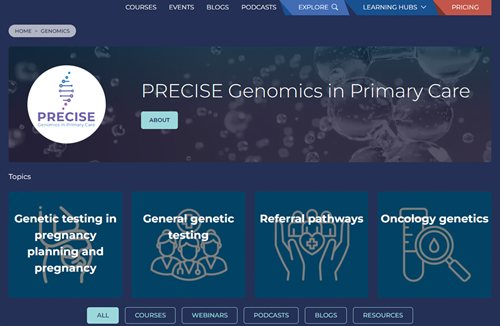 Figure 1. Front page of PRECISE Genomics Hub on Medcast.
Reproduced with permission from Medcast.
Conclusion
Genomics is becoming a routine part of reproductive care. The PRECISE Project equips GPs with the tools and confidence to offer RGCS and NIPT/S, enhancing patient-centred care and informed decision making. Ongoing education and support are essential for successful integration of genomics into general practice.
Key points
- Genomics is increasingly relevant in reproductive care.
- RGCS and NIPT/S can be offered in general practice with appropriate tools.
- PRECISE provides CPD-accredited resources and point-of-care guides.
- Shared decision making and timely referral are essential.
- Genomic integration improves patient outcomes and supports personalised care.
Acknowledgements
The authors wish to acknowledge the PRECISE Genomics Research Project Group of non-author contributors who are co-investigators on this project and have provided advice and support: Clin. Prof Kristi J Jones, Sydney Children’s Hospitals Network – Westmead, The University of Sydney; Prof Robyn Jamieson, Sydney Children’s Hospitals Network, Children’s Medical Research Institute, The University of Sydney; Assoc Prof Nicole Rankin, The University of Melbourne; Prof Anne Cust, The Daffodil Centre, The University of Sydney; Prof Lynn Monrouxe, The University of Sydney; Dr Amelia Smit, The Daffodil Centre, The University of Sydney; Dr Kate Dunlop, The Daffodil Centre, The University of Sydney; A/Prof. Carissa Bonner, The University of Sydney; A/Prof Shailendra Sawleshwarkar, The University of Sydney; Dr Gerald Chitsunge, Western NSW Primary Health Network; Kirsten Boggs, Murdoch Children’s Research Institute; Edwina Middleton, Centre for Genetics Education, HETI, NSW Health; Bronwyn Terrill, Australian Genomics; Dr April Morrow, Centre for Genetics Education, HETI, NSW Health; Emma Bonser, Genetic Alliance Australia; Dr Anthony Brown, Health Consumers NSW; Nehal Singh, The Daffodil Centre, The University of Sydney.