News
Australia-first endometriosis management tool launched
It’s designed as a ‘practical roadmap for care’ in everyday general practice to support consistent, evidence-based care and reduce diagnostic timeframes.
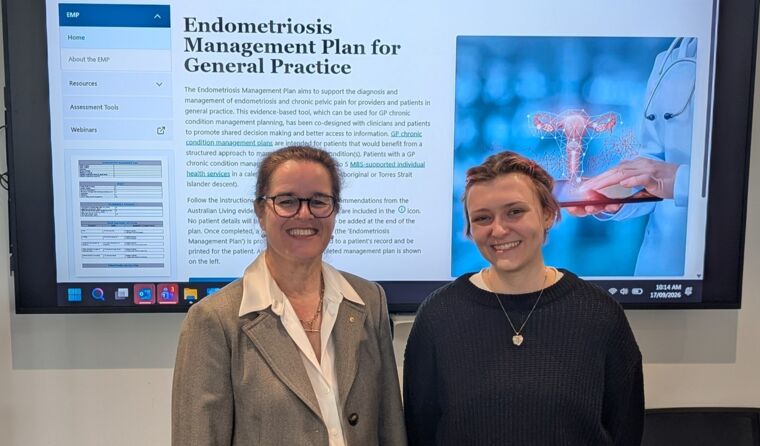 Monash University Professor Danielle Mazza (left) with lived experience advocate Lilia Tennant at the launch of the Endometriosis Management Plan at the RACGP in Melbourne.
As awareness of the far-reaching impacts of women’s health conditions grows and funding receives greater recognition, a first-of-its-kind tool is now available to support GPs in recognising, assessing and managing a common condition.
The Endometriosis Management Plan (EMP) provides ongoing, shared care for people with endometriosis and chronic pelvic pain, incorporating evidence-based guidance and practical resources, while empowering patients to make informed decisions.
The EMP is designed as a seven-step plan for GPs to do with their patients, beginning by asking what their main concerns are, then setting goals, assessments and referral pathways before collating everything into a clear plan the patient can keep on hand. Up-to-date evidence-based patient resources are also included.
The EMP includes:
- structured clinical templates
- evidence-based guidance
- practical assessment tools
- education resources, including gplearning and webinars.
Officially launched on Thursday at the RACGP’s College House in Melbourne, Wurundjeri Country, the EMP is a partnership between Monash University’s SPHERE Centre of Research Excellence and the RACGP, funded under the
National Action Plan for Endometriosis.
The new tool is hoped to drive national awareness of endometriosis and pelvic pain and be integrated into routine general practice.
Professor Danielle Mazza is Monash University’s Head of General Practice and SPHERE Director. At Thursday’s launch, she told
newsGP the tool helps to bring guideline recommendations into the consulting room.
‘We want to bring the evidence into the hands of patients to bring them the best possible care,’ she said.
‘GPs’ role is to improve our patients’ knowledge and capacity to manage their conditions ... the EMP is a great example of how we can translate evidence-based guidelines into practice,’ she said.
‘The RACGP is the natural partner to really help spread evidence-based best practice endometriosis care in our community.’
Professor Mazza says it will help to reduce diagnostic timeframes of the condition, as well as ensure patients are heard when talking about their symptoms, such as
pain and
mental health impacts.
‘We want to raise awareness of the significant condition endometriosis is for so many women. Not only the ones who know they have it, but there are many out there who are unsure and who have these terrible symptoms that are very debilitating in many cases,’ she said.
‘It can be very hard to recognise and hard to manage. It requires persistence, but it also requires a reconceptualisation that this is a chronic disease and it doesn’t have a cure, but can be better managed.
‘We hope the plan will help people to conceptualise endometriosis as a chronic disease that requires having a plan put in place, following the plan, reviewing the plan, and particularly multidisciplinary care, which we know can assist many women.’
Part of the national EMP launch is a public-facing media campaign featuring
lived experience advocates. One of those is Lilia Tennant, 22, who was diagnosed with endometriosis after six years of ‘debilitating’ pain.
Speaking at the launch, Ms Tennant touched on the importance of shared-decision making with her GP.
‘Not just to get to the bottom of an issue, but to learn about me and have an empathetic conversation about my mental health, and give me the choice,’ she said.
‘Sometimes you go to the doctor and it will feel like they’re telling you that you have to try all these things ... and you just work down the list.
‘[But it needs to be] more like a conversation about, “What do you feel comfortable doing right now? What are you able to? How much energy do you have to put into caring for yourself right now?” and letting me guide the journey a little bit more.’
Ms Tennant hopes the new EMP will help people with endometriosis and chronic pelvic pain like her to be more involved in their care.
‘Having a portal with everything in one place is amazing,’ she said. ‘All my different referrals are all over my room, and I can never find them when I need to.
‘This can be really helpful in a flare up or a stressful moment – to have something to go to – because when I’m flaring I’m just rolling around on the ground, I can’t do anything.
‘So if I can just reach out [for the EMP] and say, “Okay, I can do this”, it gives a resource that you can rely on and will hopefully make those periods a little bit easier.’
RACGP President Dr Michael Wright said the Monash–RACGP tool will support general practice in its place as the ‘cornerstone of endometriosis care’.
‘By supporting earlier management, shared decision-making and coordinated multidisciplinary care, this initiative has the potential to improve health outcomes and quality of life for people living with endometriosis and chronic pelvic pain,’ he said.
‘This new EMP gives patients and their GP a practical roadmap for care. It brings together the latest evidence and supports informed decisions about symptom management, treatment options and referrals, all within the context of an ongoing therapeutic relationship with a trusted GP.’
It is hoped the EMP will soon be integrated into practice software, and in the meantime, Professor Mazza encourages both GPs and patients to begin using it.
‘There’s no use having the guideline sitting on the shelf or computer – we need tools that get into practice and make it easy for GPs and patients to know what best practice care is,’ she said.
‘I’m really proud we’ve been able to develop this tool that brings the recommendations into the hands of both patients and their GP.’
Log in below to join the conversation.
endometriosis endometriosis management plan pelvic pain shared care women’s health
newsGP weekly poll
Have you ever found out that a patient has previously failed to disclose their use of GLP-1 medicines to you as their usual GP?