News
Bringing community voices to menstrual health
Aboriginal women’s cultural and community perspectives have informed a new suite of culturally safe resources.
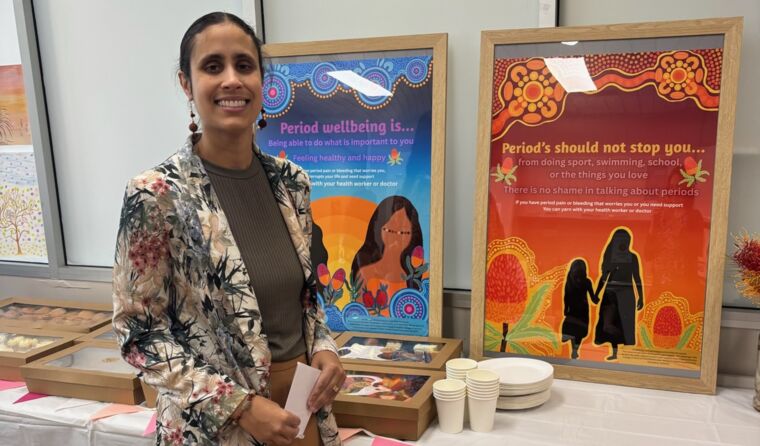 Indigenous Doctor of the Year, Dr Talila Milroy, has helped to develop new menstrual health resources for Aboriginal and Torres Strait Islander women.
A community in Western Australia has launched a suite of new resources dedicated to the menstrual health of Aboriginal and Torres Strait Islander women, driven by an Aboriginal doctor determined to make a difference.
Dr Talila Milroy, a Yindjibarndi and Palyku GP, researcher and lecturer has helped develop culturally safe co-designed menstrual health resources as part of her PhD project research, ‘Aboriginal women’s menstrual health and management in primary care’.
The results are two posters designed for clinic waiting rooms that Dr Milroy hopes will ‘plant a seed’, to let women know menstrual health is ‘something you can talk to your care provider about’, and three pamphlets across a woman’s reproductive life cycle – the first period, periods after pregnancy, and menopause.
The posters and pamphlets were developed in partnership with Dr Milroy’s main place of work, the Babbingur Mia Maternal and Child Health Aboriginal Corporation in the outer Perth suburb of Rockingham, and launched on 11 September during national Women’s Health Week.
The response to the assets has been ‘really fantastic’, said Dr Milroy, known by many as Dr Tilly.
‘A lot of comments like, “I wish I had something like this when I was younger, I wish my mum had something like this when she was going through this thing”, so that’s been amazing,’ she told newsGP.
‘The community has really been proud of them, and just proud of this work getting out there that they were involved in, which is the main thing – that we reflected their voice well and had a good result as well.’
The launch of the menstrual health assets is not the only reason for celebration – that same week, Dr Milroy was also named 2026 Indigenous Doctor of the Year by the Australian Indigenous Doctors Association.
The menstrual health resources were informed by two research projects by Dr Milroy; a scoping review of menstrual health literacy and resources for Aboriginal women, and findings from two yarning groups of women run through Babbingur Mia.
Dr Milroy said while there were set topics around periods and menstrual health within the yarning groups, the women also set some of their own directions.
‘In the course of yarning, you are really directed by the group in terms of where the conversation goes, so you can get some really insightful reflections about those lived experiences,’ she said.
The findings were then taken to an advisory group ‘to make sure that I’ve understood those findings correctly and really reflected the voice of the women and what they said’.
A local artist, Erika Fernandez, also worked with the co-design group to identify preferred colours and representations.
‘We also looked at a lot of existing resources, including some resources from overseas, just for women to get an idea of the types of things that were possible in terms of designing these resources,’ Dr Milroy said.
‘They were a good starting point with the artist as well, for her to get some inspiration around what people wanted to see and what would work.’
While the pamphlets reflect local design – and artwork and language can differ markedly across the country’s regions – Dr Milroy hopes there will be opportunity to translate them into different Aboriginal languages.
‘It’s not something we have any kind of firm plans for at the moment, but that would certainly improve the culture safety if we were able to make them more suitable to other specific locations as well,’ she said.
‘But they are absolutely available to be used anywhere.’
The pamphlets and posters will be available for download once the Babbingur Mia website is updated, which is expected to be completed shortly, but until then, Dr Milroy says general practices can contact her directly for printed copies.
Log in below to join the conversation.
Aboriginal and Torres Strait Islander health co-design culturally safe Indigenous GP menopause menstrual health perimenopause periods women’s health yarning group
newsGP weekly poll
Have you ever found out that a patient has previously failed to disclose their use of GLP-1 medicines to you as their usual GP?