News
AJGP: Seven decades of change and continuity
From a black-and-white publication to a digital resource reaching thousands of GPs, the journal celebrates its 70th birthday in 2026.
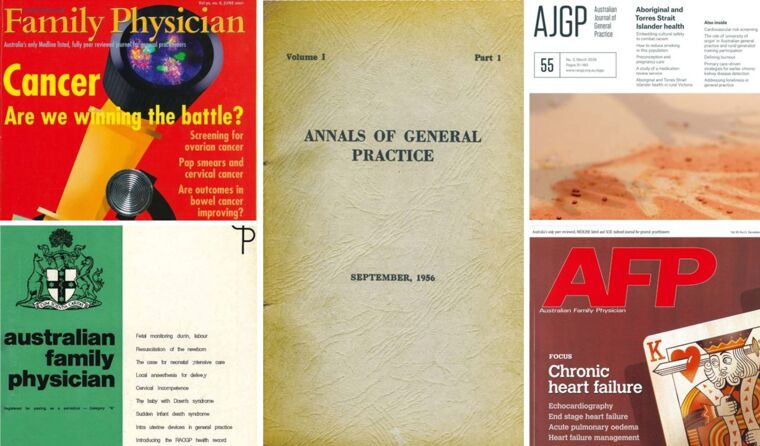 From the Annals of General Practice to Australian Family Physician, and now, the Australian Journal of General Practice.
When the very first issue of the Annals of General Practice came off the press, it set readers back two shillings and sixpence per part, or a bargain at 10 shillings per year.
It was 1956 and the journal was a black-and-white, digest-sized publication, produced by linotype and balancing cost constraints with expanding distribution.
Dr Carl Gunther’s opening editorial stipulated from the beginning that all material within its pages must be of interest to GPs, combining clinical papers, medical news and professional communication.
As the journal celebrated its 70th birthday in September 2026, ‘almost everything about how we produce and deliver the journal has changed,’ says current Editor-in-Chief, Professor David Wilkinson.
‘What has remained constant is our commitment to providing information that is relevant, practical and useful to GPs’.
After it first went to print, the Annals of General Practice became the Australian College of General Practitioners’ official journal in 1958, recording its first annual meeting.
It quickly became a quarterly publication, and colour printing was rolled out in 1961 as it became increasingly integrated with college administration, education and research.
By 1970, it was distributed to all Australian GPs, with its contents including research newsletters, postgraduate lectures, seminars and conventions.
Then, in 1972, the journal underwent a name change, becoming Australian Family Physician (AFP).
Under its foundation Editor, Dr Wesley Fabb, the new title aimed to reflect the growing identity of general practice and family medicine as a distinct discipline.
In the 70s, AFP’s scientific and educational content increased, Checkpoint introduced a self-assessment dimension, and it grew to include content on vocational training, continuing education, clinical material, quizzes, examinations, practice management and research.
‘From the beginning, the journal was intended to connect GPs with one another and with the knowledge, ideas and developments shaping their profession,’ says Professor Wilkinson.
‘Along the way, it has embraced research, clinical education, self-assessment, continuing professional development and the changing needs of the profession.’
By the time 1990 hit, AFP had reached an average circulation of 19,600, and in 1997, it launched its first website.
Over the decade, the journal increasingly combined practical clinical education, vocational training, continuing medical education and original general practice research.
As Australians celebrated the new millennium, AFP modernised once again, and as its readership reached almost 44,000, it was renamed the Australian Journal of General Practice (AJGP) in 2018.

This title change was presented as ‘reflecting the maturity of general practice as a discrete medical discipline’, while retaining the journal’s clinical and educational mission.
And today, the AJGP’s latest strategy emphasises GP authorship, college engagement, governance and digital delivery.
Its new digital magazine launched in August 2025 while print circulation remains close to 35,000.
The journal is described as an indexed scholarly publication, digital clinical resource, CPD vehicle, and professional forum.
Across its 70-year journey, the AJGP’s pages have been graced by a long list of Australia’s highest profile GPs, from Professor John Murtagh to Professor Michael Kidd.
Professor Wilkinson believes AJGP has endured because it has ‘always been a journal for GPs, shaped by the realities of general practice’.
‘Its value lies in bringing evidence and specialist knowledge into the context in which GPs work every day, helping them navigate complexity and deliver the best possible care for their patients,’ he said.
‘General practice will continue to evolve, and AJGP must evolve with it.
‘Our priority is to ensure the journal continues to publish high-quality, clinically relevant content, strengthen GP authorship and provide a platform for general practice research, so that it remains useful to GPs and ultimately benefits the patients and communities they serve.’
Read more in Professor Wilkinson’s special editorial, ‘AJGP at 70 – A journal shaped by general practice’.
Log in below to join the conversation.
AJGP Australian Journal of General Practice
newsGP weekly poll
If the annual cap on GP-referred chronic condition management services increased from five to 12 visits, what impact would it have on your patients?