News
RACGP visit to ‘beautiful’ SA city reveals workforce challenges
College leaders visited practices, a medical school and health services, finding reasons for optimism alongside recruitment concerns.
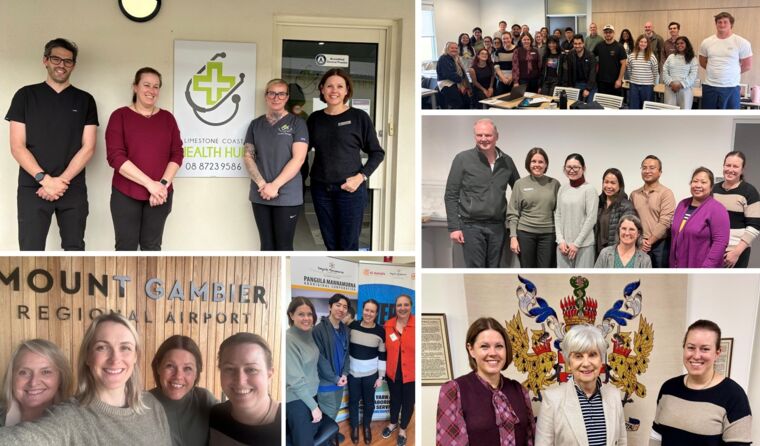 RACGP SA spent three days in Mount Gambier and Millicent last week, visiting general practices and healthcare services to hear firsthand about healthcare delivery in regional South Australia.
For those not familiar with Mount Gambier, RACGP South Australia Chair Dr Siân Goodson paints an evocative picture of the state’s second-biggest city.
‘It’s actually got a huge amount of facilities, and it’s got good restaurants and great schools, but it’s also got the most beautiful countryside around it,’ she tells newsGP.
‘It’s got the Blue Lake [Waawar], the main tourist attraction, which is in a small volcanic crater. It’s a beautiful, beautiful place, and people are really friendly and welcoming.’
It’s no wonder, then, that Mount Gambier’s population ‘expanded enormously’ during the COVID-19 pandemic, says Dr Goodson, becoming one of many rural and regional hot spots nationally to lure city dwellers to a life more bucolic and less restricted.
However, as the city’s popularity swelled, general practice struggled to keep up.
‘They just didn’t have enough doctors to cope with the demand,’ said Dr Goodson.
Attracting GPs remains an enduring challenge for regional, rural and remote Australia, as Dr Goodson and RACGP SA Rural Representative Dr Dianne Carr found last week, during a three-day tour of Mount Gambier and the nearby Limestone Coast town of Millicent.
The pair visited practices and healthcare services in Mount Gambier and Millicent, including Pangula Mannamurna Aboriginal Corporation, The Medical Clinic Millicent, Hawkins Medical Clinic, Limestone Coast Health Hub, Ferrers Medical Clinic and Village Medical Centre.
Their visit also included meetings with Mount Gambier Mayor Lynette Martin and Dr Patrick Burgon of the Flinders University Rural Medical School.
It was Dr Goodson’s first visit back in two years, during which time the shortage of GPs had become so dire that ‘all practices’ had to close their books to new patients, she said.
‘It was not long ago,’ she said. ‘There are now some that are taking new patients again, so that’s really, really good news for the community.’
She said the area relied ‘very heavily’ on international medical graduates (IMGs) to help meet demand, but happily, many had put down roots in Mount Gambier after coming from countries including Egypt, Iran, Bangladesh, Pakistan, Sri Lanka and Canada, creating their own community in the process.
‘They’re a really thriving, really lovely community that support each other,’ she said.
‘We also met some early career GPs who recently returned to their hometown to serve their community.’
However, for now it remains a ‘struggle’ to attract enough doctors and IMGs to the area, said Dr Goodson, the shortage compounded by the fact that SA also has ‘half as many’ Fellowship Support Program doctors compared to the eastern states per capita.
‘So, we know it’s a challenge,’ she said.
Yet, there are positive signs for the future. During their visit to the Flinders University Rural Medical School, Dr Goodson and Dr Carr met 30 second-year medical students in the first cohort of the new medical school.
‘They were a fantastically impressive bunch,’ Dr Goodson said.
‘They do regular testing assessments, and they are consistently doing better than the people doing the program back in the city, which is really interesting.
‘And the evidence shows that the longer medical students spend in rural settings, the more likely they are to settle in rural or regional settings. So, I think that’s quite exciting for the future as well.’
Dr Goodson said RACGP SA is advocating to the State Government for a $40,000 incentivising grant for each IMG that comes to Mount Gambier, as well as a $10,000 incentive for supervisors.
‘We think that can make a huge difference to Mount Gambier, Millicent, that whole area to help them attract more doctors, which they still desperately need,’ she said.
‘Although the crisis is averted, they still need more GPs, and there’s a population down there continuing to grow, so it’s only a matter of time before they hit the point where they have to close their books again.’
She said the Government has ‘expressed a willingness’ to reinvest income from GP payroll tax earned over the past couple of years, and funding such incentives offer an ideal opportunity to do so.
‘This is where the South Australian Government can step up and actually support GPs in South Australia specifically,’ she said.
‘This is a perfect way to do it.’
Log in below to join the conversation.
Aboriginal healthcare Fellowship Support Program international medical graduate Millicent Mount Gambier RACGP SA regional and rural road trip South Australia
newsGP weekly poll
Have you ever found out that a patient has previously failed to disclose their use of GLP-1 medicines to you as their usual GP?