News
GPs’ ‘amazing capacity’ celebrated at Health of the Nation launch
GPs and policymakers gathered on the ground in Canberra to celebrate a positive shift in general practice sentiment at the launch of the college’s flagship report.
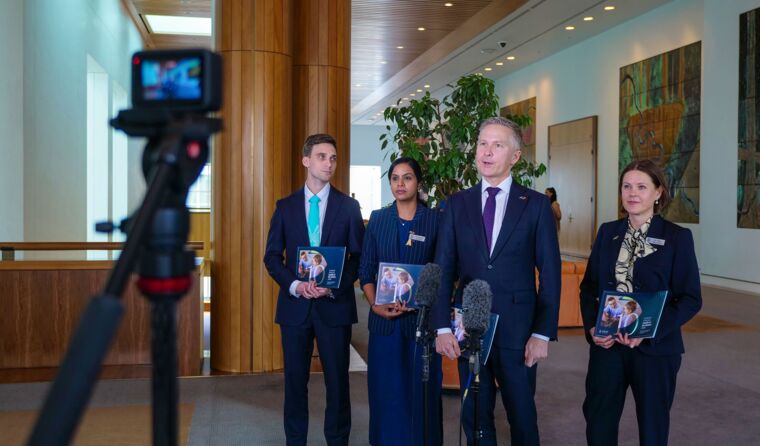 The RACGP’s Dr Joshua Preece, Dr Ramya Raman, Dr Michael Wright and Dr Siân Goodson launching the Health of the Nation report in Canberra. (Image: Jake Pinskier)
GPs from all corners of Australia have gathered with politicians and media in Canberra for the launch of the 2026 Health of the Nation report, the centre-point of the college’s biggest advocacy event of the year.
Now in its tenth year, the report offers a detailed snapshot of the state of general practice as well as an opportunity for college leaders and grassroots GPs to advocate face-to-face for the profession.
At its Wednesday morning launch in Parliament House on Ngunnawal and Ngambri Country, RACGP President Dr Michael Wright lauded GPs’ ‘amazing capacity … to adapt to the changing needs of the Australian population’.
In a speech delivered to a range of politicians of all political hues, alongside senior health officials including Chief Medical Officer Professor Michael Kidd, Dr Wright said the report’s findings make him ‘optimistic’ about the future of general practice.
‘Investing in general practice gets results,’ he said.
‘We have around 6000 GPs in training now, who are coming through having excellent experiences, and the idea of being a GP is more and more attractive.
‘I’ve attended many Fellowship ceremonies … I’ve shaken hands with more than 500 New Fellows in the last month.
‘And the enthusiasm of this workforce … already operating in communities, is palpable and that will only increase.
‘That’s a really positive sentiment for general practice, but also a positive sentiment for the community.’
Under the theme ‘General practice at the heart of a thriving health system’, the report outlines a series of positive developments including rising patient access, more patients being bulk billed at every visit, an increasing number of full-time GPs, and record numbers of GPs in training.
GPs’ job satisfaction has also leapt with 76% of those participating saying they are happy in their jobs, while more than half say they would recommend general practice as a career.
However, Dr Wright also spoke of the challenges identified by the more than 2700 Health of the Nation participants, with increasing business costs and more complex health needs.
According to the report, almost nine in 10 GPs said in the past 12 months they had managed conditions which would usually be treated by a non-GP specialist, and around three-quarters treated patients traditionally seen in emergency departments or urgent care settings.
With that backdrop, Dr Wright said reform is needed to help GPs adapt to an ageing population with a greater burden of chronic disease.
‘That complexity isn’t recognised with the way Medicare is set up,’ he said.
‘The report has suggested that we need to increase funding towards those longer consultations, the more complex consultations as a mechanism of keeping people well, and away from needing expensive hospitals or emergency departments – and getting better health outcomes.’
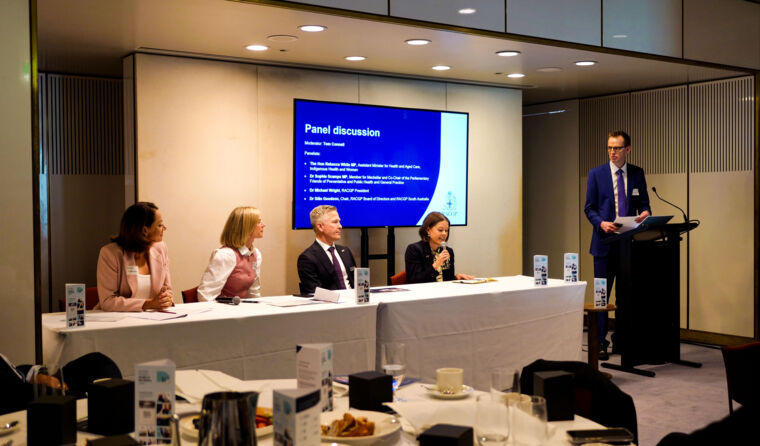
Independent MP Dr Sophie Scamps, Federal Assistant Health and Aged Care Minister Rebecca White, RACGP President Dr Michael Wright and Board Chair Dr Siân Goodson taking part in a panel discussion, moderated by journalist, Tom Connell. (Image: Jake Pinskier)
RACGP President-elect Dr Ramya Raman, the event MC, then introduced Federal Assistant Health and Ageing Minister Rebecca White, who shared the story of her grandfather, Dr Peter Pitney, who practised as a GP in Tasmania until he was 80.
‘Time and again we hear reports of how doctors help change somebody’s life,’ she said.
‘This report demonstrates to us that all those fundamental principles of trust and care and respect remain the same over the decade we’ve been doing the report.
‘It does highlight a profession that is delivering essential care while balancing serious pressures.’
She also pointed to the Government’s $8.5 billion investment into bulk billing and noted she agrees Dr Wright’s statement that ‘investing in general practice gets results’.
Assistant Minister White also took part in a panel alongside GP turned independent Federal politician Dr Sophie Scamps, Dr Wright, and RACGP Board and SA Chair Dr Siân Goodson.
In a wide-ranging discussion, they covered topics including structural gender bias in healthcare, health misinformation, as well as complexity of care and longer consultations.
Asked for an optimistic closing thought, Dr Goodson said general practice is ‘certainly not in crisis anymore’.
‘The future is bright and I love being a GP, and this report shows that many of us love being a GP,’ she said.
‘The really important message here is you can see a GP … and the data really backs that up. 99% of people can see a GP when they need to and two-thirds of people can actually see their preferred GP when they need to.’
Dr Wright echoed the positive sentiment, saying he is ‘incredibly optimistic about the capacity of GPs and the general practice workforce to adapt to the changing needs of Australia’s population’.
‘We’re the most cost-efficient part of the health system, we get the best health outcomes,’ he said.
‘We’re the greenest part of the health system, the lowest carbon part, so investing in general practice is good for individuals, good for families, good for communities, and good for the environment.’
Log in below to join the conversation.
chronic disease Health of the Nation healthcare reform mental health multimorbidity
newsGP weekly poll
If the annual cap on GP-referred chronic condition management services increased from five to 12 visits, what impact would it have on your patients?