The parotid glands represent the largest of the major salivary glands and are located in the posterior cheeks – anteroinferior to the ear, inferior to zygoma and overlying the angle of the mandible. They produce serous secretions that drain via Stenson’s duct into the oral cavity. Saliva, composed of 99% water and 1% protein and salts, is important in the digestion of food (amylase), the facilitation of taste and maintaining healthy dentition (via pH buffering, antimicrobial activity and dental remineralisation).1 Salivary flow also maintains the health of the major salivary glands, preventing the formation of sialoliths (salivary duct stones) and retrograde duct bacterial ascension.
Parotitis, inflammation and swelling of the parotid gland can occur secondary to a range of aetiologies from infections to systemic conditions (Table 1).
| Table 1. Aetiologies of parotitis |
| Types |
Aetiologies |
Acute infective parotitis
|
Acute suppurative parotitis
- Aerobes: Staphylococcus aureus, Haemophilus influenzae, Streptococcus species
- Anaerobes: Fusobacterium, Bacteroides, Peptostreptococcus
Polymicrobial infections |
Viral parotitis
- Mumps, Paramyxovirus, Epstein–Barr virus (EBV), Influenza, Parainfluenza virus, Coxsackie virus, Cytomegalovirus, HIV
|
| Chronic infective parotitis |
Tuberculosis, Actinomyces, Syphilis |
Obstructive/chronic parotitis
|
Duct/gland scarring
Salivary duct or gland stones (sialolithasis)
Neoplasms
- Benign: Pleomorphic adenomas, Warthin’s tumor
- Malignant: Mucoepidermoid carcinoma, adenoid cystic carcinoma, squamous cell carcinoma
Radiation sialadenitis
Cystic fibrosis |
Chronic autoimmune parotitis
|
- Sjogren’s syndrome
- Systemic lupus erythematosus
- Sarcoidosis (Uveoparotid fever)
- Wegner’s granulomatosis/Granulomatosis with polyangiitis
- Rheumatoid arthritis
- Immunoglobulin G4-related disease
|
Drug-induced parotitis
|
Established drugs
|
Drugs reducing salivary secretion
- Anticholinergic agents – Hyoscine
- Antiparkinsonian medications – Amantadine, Entacapone
- Antihistamines – Loratadine, Diphenhydramine
- Sulfamethoxazole
|
Metabolic causes of parotid enlargement (sialadenosis)
|
- Diabetes mellitus
- Eating disorders (anorexia nervosa, bulimia nervosa)
- Alcohol use disorder
|
History
Patients with acute, suppurative parotitis report rapid facial swelling of the cheek and neck associated with increasing severe pain.2 Classically seen in older patients, these cases manifest within a few hours to days and are generally preceded by dehydration and/or strenuous physical activity prior, resulting in reduced salivary flow – allowing for retrograde bacterial ascension up Stenson’s duct.3 Other risk factors contributing to acute suppurative parotitis include recent major surgery (eg abdominal), diabetes, immunosuppression, hypothyroidism and/or malnourishment.3
Pain from parotitis is caused by glandular inflammation and/or the accumulation of non-draining saliva, which distends the parotid capsule. Patients might report decreased oral intake secondary to pain with chewing, dysphagia, reduced mouth opening (trismus) as well as a limited neck range of motion – features secondary to the spread of inflammation from the parotid to adjacent musculature. Fevers in this context are strongly suggestive of an infectious aetiology.2
Patients reporting recurrent, unilateral episodes of parotitis in the absence of systemic symptoms might have an obstructive cause such as sialolithiasis, scarring or neoplasm. These patients generally report recurrent episodes of swelling, discomfort and reduced salivary production especially postprandially.3 Both smoking and gout have been shown to be associated with sialolithiasis4 and should be considered in patients with recurrent unilateral parotitis.
In patients with bilateral parotid swelling, systemic symptoms of fatigue, myalgias, arthralgias and night sweats should be assessed as they might indicate an underlying viral or systemic inflammatory condition (Table 1). Associated dry eyes and dry mucous membranes in the upper aerodigestive and/or genitourinary tract suggests a systemic cause such as Sjogren’s syndrome.2
Where bilateral parotitis and fevers are evident, suspect mumps before considering other viral causes. Clinically, 40–50% of patients with mumps will have associated respiratory symptoms and 20–30% of post pubertal males will develop orchitis.5 Note that 10% of mumps patients will also develop signs of aseptic meningitis.5 Despite mumps vaccinations, outbreaks continue to be documented in Australia with a higher incidence in Aboriginal and Torres Strait Islander communities (60.5% of cases from 2016 to 2019).6 Drug-induced parotitis is extremely rare; however, clozapine-induced parotitis is an established clinical entity.7 Medications diminishing saliva production such as other antipsychotics, anticholinergics, antidepressants, antihistamines and anti-Parkinsonian medications might contribute and should also be identified in the medical history.8
Examination
Parotitis presents with asymmetrical, diffuse facial swelling associated with severe tenderness, warmth, induration and erythema. The facial swelling often crosses the angle of the mandible because of the low-lying position of the parotid (Figure 1). When examining the oral cavity, the parotid papilla marks the opening of Stenson’s duct, which sits on the buccal mucosa opposite to the second maxillary premolar tooth (Figure 2). With parotitis, this papilla can be oedematous and erythematous. Salivary flow is assessed by applying pressure in a posterior to anterior direction across the parotid while observing the parotid papillae. Pus extruded here indicates bacterial infection and should be cultured to tailor antibiotic therapy. Occasionally sialoliths (salivary stones) can be extruded from the parotid duct.
Figure 1. Facial swelling secondary to acute suppurative parotitis.
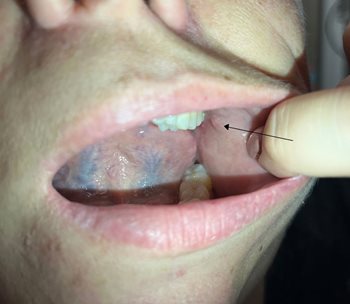 Figure 2. Stenson’s duct opening at the parotid papillae (note its position on the buccal mucosa opposite the second maxillary premolar).
Always examine for trismus, which is related to masseter and pterygoid muscle inflammation, and is described by the number of fingers a patient can fit between their incisors (less than three fingers wide indicates trismus). Observation of dentition is pertinent as this might support an odontogenic source of infection or other cause (ie widespread dental caries from xerostomia in Sjogren’s syndrome). Examining for peritonsillar or soft palate swelling is important to clinically exclude secondary complications such as parapharyngeal abscesses.
A neck examination might demonstrate reactive ipsilateral cervical lymphadenopathy. If associated with multiple, bilateral cervical lymphadenopathy, consider a viral or systemic aetiology.
Formal facial nerve (CNVII) assessment is essential as CNVII branch palsies are commonly associated with parotid malignancies.9 Although there are rare cases of benign infective parotitis and parotid abscesses being associated with CNVII branch palsy,9–11 refer these patients urgently to an ear, nose and throat (ENT) service to exclude malignancy. Other insidious features include skin changes overlying parotid masses such as tethering or ulceration.
When assessing parotid swelling, attempt to clinically distinguish between diffuse parotid swelling (seen in parotitis) and focal, discrete parotid masses, which might represent enlarged intraparotid lymph nodes, parotid abscesses or parotid neoplasms, and warrant further imaging.
Investigations
Baseline and progress serum bloods (full blood count; urea, electrolytes and creatinine; C-reactive protein) should be considered as an adjunct to monitor treatment progress.
Purulent discharge from Stenson’s duct should always be cultured to tailor antibiotic therapy after empirical therapy is commenced because although Staphylococcus aureus is the most common pathogen for acute suppurative parotitis, rates of community methicillin resistance (MRSA) infections are increasing.12 If suspecting mumps, either specific serum immunoglobulin M antibodies and/or a buccal/oral polymerase chain reaction swab should be sent for pathological confirmation.13
Where systemic causes for parotitis are being considered, further targeted blood tests should be ordered (Table 2).
| Table 2. Serum tests for systemic causes of parotitis/parotid swelling |
- Extractable nuclear antigens (Anti- Ro/SS-AA and Anti-LA/SS-BA)
- Anti-nuclear antibodies (ANAs)A,B
- Anti-double stranded DNA (Anti-dsDNA)B
- Angiotensin-converting enzyme (ACE)C
- Antineutrophil cytoplasmic antibodies (ANCAs) titres (PR3-ANCA, MPO-ANCA)D
- Erythrocyte sedimentation rate (ESR)
- Rheumatoid factor (RF)E
- Anti-cyclic citrullinated peptide (Anti-CCP)E
- Serum IgG4 levels
- HbA1C
- Viral titres and antibodies (HIV, EBV, cytomegalovirus)
- Syphilis serology (rapid plasma reagin ± fluorescent treponemal antibody absorption test, FTA-ABS)
- Monospot test (EBV)
- Mumps serum IgM antibodies
|
ASjogren’s syndrome.
BSystemic lupus erythematosus.
CSarcoidosis.
DGranulomatosis with polyangiitis.
ERheumatoid arthritis.
EBV, Epstein–Barr virus; HbA1C, glycated haemoglobin; Ig, immunoglobulin. |
Imaging is not necessary in the diagnosis of acute parotitis; however, it can be used to exclude secondary complications of infection or to exclude duct obstructions and neoplasms.
Consider ultrasonography (US) as a first-line investigation to differentiate focal parotid masses and identify sialoliths.14 Patients with parotid abscesses should be referred to hospital as they might warrant further US-guided drainage.12 US correctly identifies most calculi with a diameter of 3 mm or greater15 and demonstrates high sensitivity (94.7%) and high specificity (97.4%).16
Computed tomography (CT) scans are 96% sensitive and 100% specific in identifying sialoliths with no difference in diagnostic accuracy between contrast and non-contrast enhanced scans.17 Contrast-enhanced CTs also provide valuable cross-sectional imaging to exclude infective complications of parotitis (eg collections in the parotid or parapharyngeal space) and aid in planning surgical drainage.
Magnetic resonance imaging (MRI) has a limited role in the patient with acute parotitis; however, its high delineation of soft tissue is effective in differentiating between chronic parotitis and benign to malignant neoplastic lesions.18,19
Treatment
Parotitis can lead to extremely unwell patients ranging from the severely dehydrated to systemically ill; these patients and those identified with clinical red flags (Table 3) should be referred promptly to hospital to consider intravenous antibiotics or management of secondary complications. General practitioners should also have a low threshold to refer to hospital socially isolated or vulnerable patients, including older patients or those living in rural and remote communities.
Table 3. Red flags warranting referral to the emergency
department/specialist care |
Clinical red flags
|
- Severe limitation of neck movement, dysphagia and/or severe trismus limiting oral intake
- Systemically unwell (fevers >38°C, tachycardia, hypotension, altered mental state, malaise)
- Moderate to severe dehydration (thready peripheral pulse, fatigue, dry mucus membranes, reduced skin turgor)
- Fluctuant, localised/discrete mass overlying parotid gland
- Newly associated facial nerve branch palsy
- Fistula/sinus communicating to overlying skin
|
Imaging red flags
|
- Parotid collections/abscess
- Secondary collections (parapharyngeal abscesses)
- Septic thrombophlebitis (Lemierre syndrome)
- Parotitis with associated neoplasm detected on imaging
|
Acute suppurative parotitis
Acute suppurative parotitis treatment involves antibiotic therapy and encouraging salivary flow.
Empirical Staphylococcus aureus antibiotic coverage is vital as it is responsible for 80% of cases of parotitis; however, the incidence of anaerobic pathogens is increasing.2,18,20 A 10-day course of anti-staphylococcal antibiotics (eg Flucloxacillin 500 mg qid) is generally first-line treatment, with alternatives such as clindamycin or trimethoprim-sulfamethoxazole indicated for patients at risk of MRSA infections or penicillin hypersensitivity.2,21 Patients should be reassessed during and towards the end of the course of antibiotics to ensure clinical improvement; those with minimal responses despite 48–72 hours of treatment require an urgent referral to hospital and should have imaging considered.
Salivary flow should be promoted through early rehydration, sialagogue use (substances promoting saliva flow such as ascorbic acid, lemon juice, mints),18 application of hot compresses and regular parotid massages until symptoms resolve.22
A limited oral steroid course (eg Prednisolone 25 mg for 3 days) can be considered in patients with trismus to provide relief alongside simple analgesia; however, this should always be balanced against the risks to each individual.
Viral parotitis
Viral parotitis is generally self-resolving and is managed expectantly. Patients should continue techniques that encourage salivary flow and maintain adequate hydration.
Although there is no specific treatment for mumps, patients should self-isolate from work or school for five days after onset to reduce transmission.5 Mumps is a nationally notifiable condition and when diagnosed, requires reporting to the state health authority.5
Referral
An outpatient referral to an ENT service is indicated in the following patients:
- those who have two or more episodes of parotitis on the same side
- those who have imaging-confirmed sialolithiasis with at least one episode of parotitis on the affected side
- those with bilateral or recurrent parotitis without a clear infective/obstructive cause requiring further investigation.
Urgent outpatient referrals should be made to ENT services for patients with parotid masses, lesions or neoplasms incidentally detected on imaging.
Conclusion
Patients with parotitis require a comprehensive history and examination to investigate and manage it accordingly. Those with acute suppurative parotitis can present extremely unwell and it is these patients that should be referred to hospital for intravenous antibiotics. Incidental sialolithiasis or neoplasms of the parotid can be found in the workup of disease and these patients should be referred to ENT specialists for ongoing management.
Key points
- Acute suppurative parotitis should be managed with anti-staphylococcal antibiotics empirically and techniques encouraging salivary flow (hydration, sialagogue use, warm compresses and massages).
- Mumps should be suspected and excluded first in patients with bilateral parotitis associated with fevers.
- Consider investigating systemic causes of parotid swelling where patients have recurrent episodes or bilateral parotitis and other systemic symptoms (night sweats, weight loss, dry mouth).
- Imaging is useful to exclude obstructive causes (sialolithiasis), to differentiate between malignant and benign neoplastic lesions, and assess for secondary complications that might require hospital-level interventions.
- Clinicians should always differentiate between parotitis and a parotid mass and consider excluding malignancy in their examination and investigations.